Tuesday, December 21, 2010

Total Eclipse Of The Moon

Today marks the northern winter solstice. In addition, at about 1:30 am the moon began to pass through Earth’s shadow, turning the lunar orb an eerie shade of coppery-red.

It really was quite a show.

For a lunar eclipse to fall on the same date as the northern winter solstice, is rare. In fact scientists say that in recorded history there is only one other instance of an eclipse matching the same calendar date as the solstice, and that was in Dec. 21, 1638. That's 372 years ago!

The next won't be quite as long. It's expected in Dec. 21, 2094. That's a mere 84 years from now.

Anyways, it's -8 in southern Ontario. So I bundle up and while I am humming that old blue eyes chessnut “Fly Me To The Moon”, I bolt my 120 dollar Fujifilm 170 digital camera atop my 10 dollar mini tripod and prepare to make photographic history. But damn its cold out here!

I think of my ancient ancestors – not with digital cameras – but braving the cold night air banging on pots and pans hoping that the racket will scare of the evil demons who appeared to be in the process of making off with the moon.

No pots and pans being beat tonight. In fact it's very quiet. I appear to be only one out here. A police cruiser approaches, stops to assess the situation, and content that I don't appear to be carrying any burglary tools, continues his appointed rounds.

After a bunch of editing, I managed to put a few shots together. Not to worry, however. I plan to be much better at this in time for the next one.


Sunday, December 19, 2010

Urban Art

A photo collection of wall murals and grafetti taken in various parts of Ontario.


On the wall of a hairdressing establishment Queen Street Brampton.


One of several pieces of art commissioned by Cameco in Blind River. This particular art is displayed on the wall of one of my favorite watering holes the Iron Horse Tavern.


Another work commissioned for Comeco. This one is on a side wall of the Blind River branch of the Royal Bank.


Art work on the side of a variety store in Blind River commemorating the area's logging industry. The McFadden Mill was the largest white pine mill in Canada with an annual capacity of 120,000,000 board feet (280,000 m³) of lumber


Cobalt Ontario. Large mural on the upper walls of the local legion hall depicting Cobalt's rich mining history.


Cobalt Ontario. Beautiful mural shows 100 years of Ontario Povincial Police presence in the mining community.


Cobalt Ontario. Large mural depicting the famous Lang Street as it probably looked in the early 1900's.


Cobalt Ontario. Naval ships depicted outside the military museum (the Bunker).

Saturday, December 18, 2010

Your Birthday


So, on the 21st of December you will be celebrating your birthday. Oddly, my own birthday is the following day.

I thought that you might be interested in these few notes that I've collected.

For starters people like youself born on December 22 are considered as very special to the folks who study the stars and plants. I quote;

"Few people have such power of self-determination as a Sagittarius born on December 21. They can transform themselves from ugly duckling to beautiful swan. When an idea grabs them, they can make their dreams reality. They quickly spot intellectual dishonesty."

And, as you might guess, it does not stop there.

"These men and women subconsciously seek out friends who can give them validation. They seldom become romantically involved with someone who lacks the potential to be a friend. They place great importance on partnership in marriage."

Also on your birthday is the total eclipse of the moon. According to NASA, "if the weather is clear, favorably placed skywatchers will have a view of one of nature's most beautiful spectacles."

You share your birthday with some of the most talented and beautiful people on our planet.


Samual L. Jackson the actor

Keifer Sutherland the actor

Charlie Watts the drummer for the Rolling Stones

Chris Evert legendary tennis player

Jane Fonda actress. Who could forget her in Barbarella? (Not me!)

My birthday, on the other hand, is not quite as wonderful.

Those quacks who spend all their time gazing at the stars and planets (when they could be doing better things) are saying that people born on my date in December are 'arrogant','indecisive' and 'prone to being cranky'. What nerve these people have! I'll write them a letter! Maybe.

And, it does not stop there.

The poster boy for the 22 of December is none other that Umar Farouk Abdulmutallab. Dont remember him?


He's the 'Christmas Underwear Bomber'.

What a difference a day makes!

Wishing you a happy birthday.

Sunday, December 5, 2010

The Four Sisters


The Circle of Life. "One generation passeth away, and another generation cometh; but the earth abideth forever… The sun also ariseth, and the sun goeth down, and hasteth to the place where he arose… The wind goeth toward the south, and turneth about unto the north; it whirleth about continually, and the wind returneth again according ...to its circuits… "
– Ecclesiastes

Mildred Pearl Brazeau (Bateson) 27 August - 13 January 2000, Helen Charlotte Kidd (Bateson) 21 May 1924 - December 4, 2010, Catherine Elizabeth Haddow (Bateson) 3 August 1928 - 7 November 2009, Lorna Jean Brazeau (Bateson) 12 May 1920 - 23 November 1986.

Sunday, November 28, 2010

The Edmund Fitzgerald

“Keep us, our God; for your ocean is so wide and our boat is so small.”

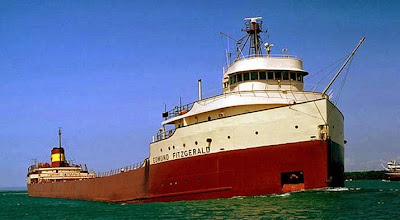


It was 35 years ago this month that the Edmund Fitzgerald sank with all hands on board.

This is my tribute.

The Fitzgerald left Superior, Wisconsin, at 2:15 p.m. on the afternoon of Sunday, November 9, 1975, under the command of Captain Ernest M. McSorley. It was en route to the steel mill on Zug Island, near Detroit, Michigan, with a full cargo of taconite ore pellets.

The Fitzgerald joined a second freighter under the command of Captain Jesse B. "Bernie" Cooper, Arthur M. Anderson, destined for Gary, Indiana out of Two Harbors, Minnesota. The weather forecast was not unusual for November and the National Weather Service (NWS) predicted that the storm would pass just south of Lake Superior by 7:00 a.m on 10 November.

The SS Wilfred Sykes loaded opposite the Fitzgerald on at the Burlington Northern Dock #1 and departed at 4:15 p.m. about 2 hours behind the Fitzgerald. Captain Dudley J. Paquette of the Sykes predicted that a major storm would cross directly across Lake Superior instead of the NWS forecast that it would pass with less intensity to the south.

From the outset, Paquette chose a route that avoided the worst effects of the storm by using the protection of Lake Superior’s north shore. The crew of the Sykes followed the radio conversations between the Fitzgerald and Anderson during the first part of their trip and overheard their captains decide to take the regular Lake Carriers’ Association downbound route.

Paquette reported that on 10 November after 1:00 a.m., he overheard McSorley say that his ship was working so much that he had reduced his RPMs. Paquette said he was stunned to later hear McSorley, who was not known for turning aside or slowing down, state, “We’re going to try for some lee from Isle Royale. You’re walking away from us anyway … I can’t stay with you.”

The Fitzgerald followed the Anderson for the first 10 to 11 hours and then the faster Fitzgerald pulled ahead at about 3:00 a.m. on 10 November.Crossing Lake Superior at about 14 knots (26 km/h; 16 mph), the boats encountered a massive winter storm, reporting winds in excess of 50 knots (93 km/h; 58 mph) with gusts up to 86.9 knots (160.9 km/h; 100.0 mph) and waves as high as 35 feet (11 m). Visibility was poor due to heavy snow. The NWS upgraded the forecast to gale warnings. The freighters altered their courses northward, seeking shelter along the Canadian coast. Later, they would cross to Whitefish Bay to approach the locks. When the storm became intense, the Soo Locks at Sault Ste. Marie were closed.

Early in the morning of Monday, 10 November, the NWS issued a storm warning (expected winds over 48-knot (89 km/h; 55 mph). By late in the afternoon sustained 50-knot (93 km/h; 58 mph) winds were observed across eastern Lake Superior. Anderson was struck by a 75-knot (139 km/h; 86 mph) hurricane-force gust.

At 3:30 p.m., Captain McSorley radioed the Anderson to report that she was taking on water and had top-side damage including that the Fitzgerald was suffering a list, and had lost two vent covers and some railings. Two of the Fitzgerald's six bilge pumps were running continuously to discharge shipped water.

At about 3:50 p.m., McSorley called the Anderson to report that his radar was not working and he asked the Anderson to keep them in sight while he checked his ship down so that the Anderson could close the gap between them. Fitzgerald was ahead of Anderson at the time, effectively blind; therefore, she slowed to come within 10 miles (16 km) range so she could receive radar guidance from the other ship.

For a time the Anderson directed the Fitzgerald toward the relative safety of Whitefish Bay. McSorley contacted the U.S. Coast Guard station in Grand Marais, Michigan after 4:00 pm and then hailed any ships in the Whitefish Point area to inquire if the Whitefish Point light and navigational radio beacon were operational. Captain Cedric Woodard of the Avafors answered that both the light and radio direction beacon were out at that moment.

Around 5:30 p.m., Woodward called the Fitzgerald again to report that the Whitefish point light was back on but not the radio beacon. When McSorley replied to the Avafors, he commented, "We're in a big sea. I've never seen anything like it in my life."

The last communication from the doomed ship came at approximately 7:10 p.m., when Anderson notified Fitzgerald of an upbound ship and asked how it was doing. McSorley reported, "We are holding our own." A few minutes later, it apparently sank; no distress signal was received. Ten minutes later Anderson could neither raise Fitzgerald by radio, nor detect it on radar.


Anderson's Captain Cooper first called the United States Coast Guard in Sault Ste. Marie at 7:39 p.m. on channel 16, the radio distress frequency. They instructed him to call back on channel 12 because they wanted to keep their emergency channel open and they were having difficulty with their communication systems, including antennas blown down by the storm. Cooper then called the upbound saltwater vessel Nanfri and was told that they could not pick up the Fitzgerald on their radar.

Cooper repeatedly attempted to raise the Coast Guard again but was not successful until 7:54 p.m. when they asked him to keep watch for a 16-foot outboard lost in the area. At 8:32 p.m., Cooper all but pleaded with the U. S. Coast Guard to take him seriously that the Fitzgerald had gone missing.[6] Petty Officer Philip Branch would later testify, "I considered it serious, but at the time it was not urgent."

The Coast Guard lacked appropriate search-and-rescue vessels to respond to the Fitzgerald disaster. They asked the big commercial vessels to voluntarily join the search. The Coast Guard asked the Anderson to turn around and look for survivors. The initial search for survivors consisted of the Arthur M. Anderson, and a second freighter, SS William Clay Ford. The efforts of a third freighter, the Canadian vessel Hilda Marjanne, were foiled by the weather. The Coast Guard sent a buoy tender from Duluth, Minnesota, Woodrush, that was able to launch within two and a half hours, but took a day to arrive at the search area.

The Traverse City, Michigan Coast Guard station launched a HU-16 fixed wing search aircraft that arrived on the scene at 10:53 p.m. and a HH-52 helicopter with a 3.8-million-candlepower searchlight that arrived at 1:00 a.m. on 11 November. Canadian Coast Guard aircraft joined the three day search. The Ontario Provincial Police established a beach patrol all along the eastern shore of Lake Superior.

The search recovered debris, including lifeboats and rafts, but no survivors from the 29 man crew.

Although it is among the most well known and the largest vessel lost, the Fitzgerald is not alone on the bottom of the Great Lakes.

In the period between 1816 when the Invincible was lost to the sinking of the Fitzgerald in 1975, the Whitefish Point area has claimed at least 240 ships.


Today

The day after the wreck, Mariners' Church in Detroit rang its bell 29 times; once for each life lost.

The church continues to hold an annual memorial, reading the names of the crewmen and ringing the church bell. On November 12, 2006, two days after the 31st anniversary of the sinking of the Edmund Fitzgerald, the church broadened its memorial ceremony to include the more than 6,000 lives lost on the Great Lakes. In 2006, the bell at Mariners' Church tolled eight times, not the usual 29: five times for the five Great Lakes, a sixth time for the St. Clair and Detroit rivers, a seventh for the St. Lawrence Seaway and an eighth time for military personnel whose lives were lost.

The ship's bell was recovered from the wreck on July 4, 1995. There was an uproar of controversy when Jeff Stevens, a maintenance worker of St. Ignace, refurbished the bell by stripping the protective coating applied by Michigan State University experts. The controversy continued when the Great Lakes Shipwreck Museum tried to use the bell as a touring exhibition resulting in family members of the crew halting the effort by objecting that the bell was being used as a “traveling trophy”.

The bell is on display in the Great Lakes Shipwreck Museum in Whitefish Point near Paradise, Michigan. An anchor from Fitzgerald lost on an earlier trip was recovered from the Detroit River and is on display at the Dossin Great Lakes Museum in Detroit, Michigan. Artifacts in the Steamship Valley Camp museum in Sault Ste. Marie, Michigan include two lifeboats, photos, a movie of the Fitzgerald and commemorative models and paintings.

On every November 10 the Split Rock Lighthouse in Silver Bay, Minnesota emits a light in honor of the Edmund Fitzgerald.

Coast Guard Cutter Woodrush was replaced by a brand new buoy tender in 2001, USCGC Maple. On its maiden voyage, the Maple visited the final resting place of the Fitzgerald and dropped the last Woodrush life ring down to the wreck.

On August 8, 2007, a Michigan family discovered a lone life saving ring on the Keweenaw Peninsula along a remote shore of Lake Superior that seemed to be from the Fitzgerald. It was thought to be a hoax because there are considerable differences in the markings of proven rings found at the wreck site. A later Associated Press article confirmed that the life ring was not from the Fitzgerald.


The Wreck Of The Edmund Fitzgerald
By Gordon Lightfoot

The legend lives on from the Chippewa on down
of the big lake they called "Gitche Gumee."
The lake, it is said, never gives up her dead
when the skies of November turn gloomy.
With a load of iron ore twenty-six thousand tons more
than the Edmund Fitzgerald weighed empty,
that good ship and true was a bone to be chewed
when the "Gales of November" came early.

The ship was the pride of the American side
coming back from some mill in Wisconsin.
As the big freighters go, it was bigger than most
with a crew and good captain well seasoned,
concluding some terms with a couple of steel firms
when they left fully loaded for Cleveland.
And later that night when the ship's bell rang,
could it be the north wind they'd been feelin'?

The wind in the wires made a tattle-tale sound
and a wave broke over the railing.
And ev'ry man knew, as the captain did too
'twas the witch of November come stealin'.
The dawn came late and the breakfast had to wait
when the Gales of November came slashin'.
When afternoon came it was freezin' rain
in the face of a hurricane west wind.

When suppertime came the old cook came on deck sayin'.

"Fellas, it's too rough t'feed ya."
At seven P.M. a main hatchway caved in; he said,
(*2010 lyric change: At 7 p.m., it grew dark, it was then he said,)
"Fellas, it's bin good t'know ya!"
The captain wired in he had water comin' in
and the good ship and crew was in peril.
And later that night when 'is lights went outta sight
came the wreck of the Edmund Fitzgerald.

Does any one know where the love of God goes
when the waves turn the minutes to hours?
The searchers all say they'd have made Whitefish Bay
if they'd put fifteen more miles behind 'er.
They might have split up or they might have capsized;
they may have broke deep and took water.
And all that remains is the faces and the names
of the wives and the sons and the daughters.

Lake Huron rolls, Superior sings
in the rooms of her ice-water mansion.
Old Michigan steams like a young man's dreams;
the islands and bays are for sportsmen.
And farther below Lake Ontario
takes in what Lake Erie can send her,
And the iron boats go as the mariners all know
with the Gales of November remembered.

In a musty old hall in Detroit they prayed,
in the "Maritime Sailors' Cathedral."
The church bell chimed 'til it rang twenty-nine times
for each man on the Edmund Fitzgerald.
The legend lives on from the Chippewa on down
of the big lake they call "Gitche Gumee."
"Superior," they said, "never gives up her dead
when the gales of November come early!"

Wednesday, November 17, 2010

POW Camp Bowmanville


Originally built in the pre-WWII era as a school for "errant" boys, housing approximately 300 of them. Surrounded by farms, it seemed the perfect place to turn troublesome young boys, into responsible adults. Fate, it would seem, had something else in mind for these idyllic grounds.

When the war broke out in 1939, the Allies discovered that they needed a place to house their many German prisoners of war; a place where they would have difficulty escaping and possibly re-joining their former units. To meet these ends, the Canadian government built, or took over, many locations for use as POW camps. This location, officially known as Camp 30 at the time, was one of them.

The construction of the POW camp was fairly simplistic, all of the existing buildings were used. Wooden barracks, guard towers, and barbed wire fencing were all constructed. The outside perimiter security consisted of two 12-foot-high fences with electric lights every 12 feet and nine guard towers, topped off with approximately 60 miles of barbed wire. The size of the grounds is around 14-acres. Many of those original brick buildings are still standing today.

The camp served as home to German army officers from the Afrika Korps, fliers from the Luftwaffe, and Kriegsmarine officers. The new occupants were transferred from other POW camps at Neys, Fort Henry, Gravenhurst and Britain. In June 1942, the prisoner count was 487 officers, 21 midshipmen, and 135 other men of various rank. Those prisoners were guarded by a force headed by Lieutenant Colonel R.O. Bull M.C., consisting of a large support staff, the Veterans Guard of Canada, nine officers, and 239 other ranks.

By most accounts, things were fairly civil at the camp, barring one large, 3-day incident known simply as "The Battle of Bowmanville.

Lieutenant Colonel James Mason Taylor, Commandant of Camp 30 Bowmanville requested that General major Georg Friemel, the spokesman for the German POWs, have a group of prisoners volunteer to be shackled at about 12:30 PM on 10 October 1943. Friemel’s response was that none of the prisoners would volunteer. The senior German Army officer Generalleutnant Hans von Ravenstein, senior Luftwaffe officer Oberstleutnant Hans Hefele and senior naval officer Korvettenkapitän z.S. Otto Kretschmer were also requested to supply volunteers to be shackled – they declined.

Later that day the German prisoners did not show for roll call. Taylor called for reinforcements from Barriefield and Kingston, which are about 170 kilometers from Bowmanville. The guards at Bowmanville were reactivated WWI veterans called the Veterans Guard of Canada who were too old to fight in battle. They were men who were in their fifties and sixties and not physically capable of taking on the young men who outnumbered them. Although the guards had come to know the prisoners personally and were at ease with them, the prisoners now observed that there was an uneasiness about the guards as they no longer carried their weapons casually.

Lieutenant Colonel Taylor called in his officers and told them that 100 German officers were to be shackled – to use force if necessary. In a brick building that housed a large kitchen Kretschmer set up his resistance headquarters. About 150 officers and petty officers armed with sticks, iron bars, table legs, ketchup bottles, china and stones barricaded themselves inside the brick building. They were prepared for a long siege. In the other buildings similar preparations were being made. Kapitänleutnant Horst Elfe, commander U-93, recalls, “We were determined, but a little frightened too. We thought the Canadians would come in with machine guns and tear gas and grenades, because that is what would have happened in Europe. So we were shattered when we looked from our windows and saw the Canadians marching in with no guns, no gas just baseball bats over their shoulders.”

On Saturday 10 October a contingent of guards armed with rifles with fixed bayonets rushed the kitchen. Prior to the charge the Canadian officers had made a careful inspection to insure that the guards did not have any live ammunition. A pitched battle ensued at the doors and windows with the Canadian guards withdrawing, unable to penetrate the fortifications. The Germans had barricaded the doors and windows with mattresses and cardboard. The guards rushed one of the other buildings and were again beaten off. A third attack against the wooden barracks met with equal resistance. The battle went on for more than an hour. The guards brought axes attempting to chop their way through the fortified doors.

In a counter attack the POW’s exited the buildings and attacked the flanks of the guards with sticks and steel bars. Both sides suffered injuries consisting of broken bones, cracked heads and bloody noses. After a short rest the guards regrouped, attacking with high-pressure fire hoses. Water shot through the windows thoroughly dousing the prisoners. The guards gained a foothold, as the POW’s had no defense against the high-pressure water stream. The prisoners fought back until 6:00 PM. Exhausted, they finally surrendered.

The Germans who were barricaded in the basement of House 5 were forced to leave when the basement was flooded with the water from the fire hoses. As they exited Lieutenant G.E. Brent struck each POW on the head or face with his cane. The prisoners took no action as they were forced to run through a gauntlet of Canadian guards. However, they avowed to address the insult at another time.

Again Generalmajor Friemel was requested to hand over prisoners for shackling. He refused again. The hostilities ceased and by mutual agreement the prisoners returned to their barracks. The prisoners were assembled and Lieutenant Colonel Taylor informed them that he had sent for reinforcements, regular troops from a nearby army camp.

At approximately 7:45 PM, three officers and 50 enlisted men arrived. Taylor addressed the Veterans Guard and the 53 regular army reinforcements. Then the combined force of about 150 men entered the confines of the camp at 9:20 PM. A second convoy under the command of Captain Stevens from the Ordinance Training School arrived at 10:10 PM. Taylor assumed command of the new group and they entered the camp with fixed bayonets. Nothing happened as the POWs remained in their barracks. Taylor reported that everything was calm at 1:00 AM Sunday 11 October.

The large contingent of regular army troops was not expected to arrive until the morning of Monday 12 October. At about 5:20 AM, during a transfer of POWs to the Dutch farm, it was determined that two officers were missing and an “escape plan” was put into effect at 6:40 AM. At about the same time a shot was heard. A guard had taken a shot at the two escaping prisoners who were quickly captured at 7:15 AM.

During the early morning roll call Kretschmer advised the guards that it would be unwise for Lieutenant Brent to enter the compound until the ill feelings of the POWs had subsided. The POWs refused to turn out for the 7:30 AM roll call. Even though he had been warned, Brent entered the compound sometime before 9:00 AM and began walking around with an elderly guard who was well liked by the POW’s. The word spread quickly that Brent was in the camp. Brent and the guard walked around the corner of the House 4 to be confronted by Kretschmer who had been talking with Luftwaffe pilots Oberleutnant Erwin Moll and Major A. von Casimir.

As Brent turned around Kretschmer immediately punched him in the face. At this moment the guard pushed Moll aside and said, “You can’t do that!” trying to help Brent. Moll slugged the guard on the neck to take him out of the action and was immediately concerned that he had severely hurt the elderly guard who was now unconscious. Kretschmer knocked Brent to the ground and beat him soundly in retribution for the previous day’s indignity. They then dragged Brent into House 4. Oberfähnrich z.S. Volkmar König, who was the deck gun officer aboard U-99 with Kretschmer when it was sunk, observed Kretschmer rubbing his bruised knuckles as he entered and was ordered to tie up Brent. König tied Brent’s hands behind his back with strips of cloth. Brent was bleeding from the mouth and nose.

In the mean time the elderly guard recovered from the punch on the neck and gave the alarm. Kretschmer decided to mockingly march Brent to the gate. In doing so a tower-guard opened fire on the group and wounded König. When the rifle firing started Brent hit the dirt. The Germans jumped back inside the barracks leaving Brent behind as the rifle fire kicked up the dust and blew out fragments of masonry from the brick building. Once inside the barracks it was determined that König had received several wounds. They looked out the window just in time to see Brent making a dash for the gate. The remainder of the day was uneventful and König was sent to the hospital to have the masonry and bullet fragments removed and the bullet wound just above his left knee attended to.

On Monday morning, 12 October the regular army troops from Barriefield and Kingston arrived at 5:20 AM under the command of Major D.F. Adams. The young troops who had been undergoing commando training were eager for a little action. In battle dress that included WWI style broad rimmed-helmets, rifles with fixed-bayonets, clubs and fire hoses they stormed the barracks. Armed with fire axes, stones and hockey sticks Kretschmer and his crew, with pillows lashed to their heads, waited for the coming battle. The battle raged with the Germans’ first line of defense purposely giving way, retreating to the barracks.

The Canadians surged forward only to find themselves being attacked by prisoners hurling bricks from the roof of the barracks, forcing the Canadians to withdraw. With 400 troops the Canadians charged the barracks again caving in the doors and windows. The battle continued all afternoon with an ebb and flow. The battle took on the proportions of a medieval siege with the Canadian troops climbing ladders to reach the roofs of the barracks and the Germans repelling the invaders. Fortunately the Canadians had removed their bayonets and decided to physically subdue the Germans. The battle was over by early evening.”


After The War

When the war ended in 1945, all of the camp's prisoners were sent home and the site was returned to its previous use, as a boy's camp. It served this purpose until an undetermined time later, when it was no longer needed and shut down. To the best of my knowledge, the government still retained ownership of the property at this time.

Sometime later, the land and the buildings were rented out by the Peterborough, Northumberland, Clarington Catholic District School Board for use as a school. The grounds housed St. Stephens Secondary School and, for a brief time, St. Joseph's Elementary School.

In approximately 1999, St. Stephens left the property and moved into a new building a short distance away. It was at this time that Great Lakes College bought the land from the goverment, to be used as an international school for Asian immigrants. Students would come to the school to obtain Canadian highschool credits and go on to post-secondary education.

Bizarre Murder

Originally, Great Lakes College (Bowmanville Campus) was owned by a businessman named Thomas Ku. However, he was killed after a bungled kidnap and ransom attempt by two of his students, Zhiyang Suo and Feng Wang. They took him hostage as he was getting out of his car, at his Mississauga home, after visiting the school's campus. While their motive seems to be unclear, many students have complained about sub-standard services at the school, as well as not being offered services promised.

The land is currently sitting abandoned awaiting its fate. Many arson attempts have been made, and the town is attempting to restore it.

Escape from Bowmanville

In 1943, Nazi officials arranged an escape plan for several German prisoners including Otto Kretschmer, a top U-Boat ace in the Nazi army.

The Germans arranged for a U-Boat to pick the prisoners up on September 27, 1943, off the coast of New Brunswick. To meet their deadline, the prisoners began digging a tunnel beneath the POW camp in Bowmanville.

Tin cans and a crude railway system hauled the dirt out of the tunnel and into the attic of one of the camp buildings. At one point, the ceiling of the building that held the dirt collapsed, however, by this time the camp guards and the RCMP were aware of the Germans' plan and chose not to intercept. Closer to the date of escape, the RCMP finally moved in, collapsed the tunnel and seized the POW’s responsible for implementing the plan. Otto Kretschmer did not escape.


A part of the elaborate escape plans life size dummies would be made to fool guards into believing that all POW's were accounted for.


Otto Kretschmer was one of Hilter's favorite's, a U Boat commander responsible for sinking the greatest tonnage of allied shipping. He personally ordered that a plan be put in place to rescue him from Canadian hands. The RCMP however,foiled the effort.


Some of the high ranking Nazi officers held at Camp 30